
In January 1986 Israel/Palestine was in the middle of a severe drought. The water level of the Sea of Galilee had become very low. Two men were out walking when they discovered that the low water exposed the remains of a boat. The Galilee Boat or “Jesus Boat” was found on the western shore of the Sea, just north of Magdala—the home of Mary “Magdalene” (that is, Mary from Magdala) who travelled with Jesus, witnessed his crucifixion, and discovered his resurrection.
The boat had a square sail with 3 oars on each side which we see in the “Magdala Boat Mosaic” found only about a 1 mile (1.6km) from the Jesus Boat. Ther boat was 8.2m (27 feet long) x 2.3m (7 feet 7 inches) wide. Those are the measurements of the boat-shaped gap between our seats this morning, so we cans see for ourselves the size of the boat. It had room for a crew of 8 to 16—Jesus and his disciples would make 13! Radiocarbon analysis and the design of the boat date it from the First Century BC to about AD 70 which includes Jesus’ earthly lifetime which was from about 4 BC to AD 30/33. We know that the boat was repaired many times and used for several decades, so is therefore possible that it existed when Jesus was working around the Sea of Galilee. It is certainly the style of boat that was used for fishing there in the first century AD. [For more on the boat and its discovery, read the articles by Shelley Wachsmann listed below].
The four Gospels contain at least 76 references to the Sea/Lake, and to fishing, and sailing activities on or around the Sea of Galilee which were an important part of Jesus’ ministry. Jesus and his father Joseph are called in Greek a tekton (Matthew 13.55 & Mark 6.3) from which we get English words like technical, technology etc. This word refers to a “carpenter or construction worker” who could work with wood, metal or stone. It is possible that Jesus himself may have sometimes worked at boat building or repairs before he began his public ministry.
In the Gospel of Mark, Jesus takes 6 boat trips, one of them in today’s Bible reading from Mark, chapter 4, says:
Mark 4.35–36 (NRSV)
35 On that day, when evening had come, he said to them, “Let us go across to the other side.” 36 And leaving the crowd behind, they took him with them in the boat, just as he was. Other boats were with him.
The Sea of Galilee is really a freshwater lake (the Hebrew word “Yam” is used for both). It is the largest body of fresh water in Israel/Palestine. The Sea is 21km long and 13 km wide and covers around 40 000 acres. In Hebrew it is called “Kinneret” which means “harp,” perhaps because from the hillside around the Sea the lake looks a bit like the musical instrument.
In the reading Mark tell us that,
Mark 4.37–38 (NSRV)
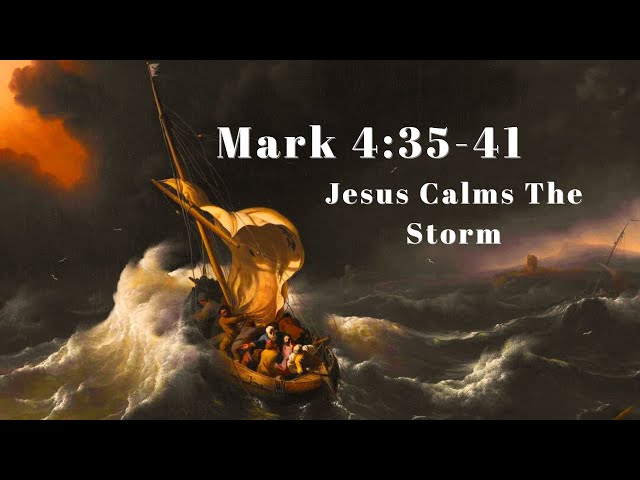
37 A great windstorm arose, and the waves beat into the boat, so that the boat was already being swamped. 38 But he was in the stern, asleep on the cushion; and they woke him up and said to him, “Teacher, do you not care that we are perishing?”
The Gospel stories that mention a sudden storm are told by people familiar with the lake: “in a few minutes the lake can sometimes turn from a peaceful lagoon into a high sea with waves soaring up over 7 feet …” [Rousseau & Arav, page 246]. It is said that the storms can be so violent that fish are cast onto the shore and later collected by the people living by the shore.
It is important for us to know that as there wasn’t a lot of water in their land, most of the ancient Israelites were land-loving people and in their minds the sea was unpredictable and threatening (read, for example, Psalms 46.3; 65.7; 89.9; and Jonah 1.15). At least of Jesus’ disciples (Peter & Andrew, James & John), however, were fishermen and they had probably lived by and on the Sea all their lives. But they all feared for their lives (verse 38). Therefore, it seems that this was a really violent storm.
Not surprisingly, for most people doubts often seem to be strongest in times of crisis. When the going gets tough we can have doubts about whether God’s saving presence is really with us. In my experience we don’t usually doubt God when things are going well. We might let God slip out of our lives because we start to act as if we no longer need God, but we are less likely to doubt because of a crisis of confidence. In the Gospels we see that it was in times of crisis that Jesus’ disciples also had doubts.
So what was Jesus doing about this storm? He was asleep! I don’t know about you, but as I look at the outline of the boat between our seats this morning—7 feet 7 inches wide—and I think of waves maybe 7-foot high crashing against the boat (I’m only 6 feet tall so they were higher than me), I’m pretty sure I would have been joining in the panic and I’m positive I wouldn’t have been asleep! But Mark says that when his disciples woke him up,
Mark 4.39–40 (NRSV)
39 He woke up and rebuked the wind, and said to the sea, “Peace! Be still!” Then the wind ceased, and there was a dead calm. 40 He said to them, “Why are you afraid? Have you still no faith?”
In the world of the disciples, there were plenty of magicians, miracle workers, and exorcists were believed to have performed miracles like some of Jesus’ early healings of the sick, but only God could still a raging storm. In the Old Testament only God had control over the sea. During the exodus from Egypt, of course, God parted the sea to allow the people of Israel to escape. And in the Psalms, we read about both the people’s fear of the stormy sea and God’s power over the storm and the waves. For example, in Psalm 107:
Psalms 107.26–29 (NSRV)
26 They mounted up to heaven, they went down to the depths;
their courage melted away in their calamity;
27 they reeled and staggered like drunkards,
and were at their wits’ end.
28 Then they cried to the LORD in their trouble,
and he brought them out from their distress;
29 he made the storm be still,
and the waves of the sea were hushed.
Here we come to the question at the heart of this story. Jesus makes it clear that the real issue here is not the wind and the waves. His disciples would have believed that God could still the storm, but did they believe that Jesus could do it? It seems like they had some serious doubts.
Mark 4: 41 (NRSV)
41 And they were filled with great awe and said to one another, “Who then is this, that even the wind and the sea obey him?”
As New Testament scholar Pheme Perkins points out, “In order to overcome their fear, the disciples must recognize that Jesus is not a human being with unusual abilities to preach, heal, and exorcise. They must acknowledge that Jesus is the Son of God” [Perkins, p. 580].
The focus of this story on who Jesus is has some important implications for us. It does mean we can trust Jesus with our lives because he is not just another human being—he is the Son of God. And above all, as we read later in Mark’s Gospel, he didn’t just calm the wind and the waves, he gave his life for us (read chapter 15), and then was raised to life by God (read chapter 16). But it doesn’t mean that God will always do whatever we want whenever we want it. It doesn’t mean that we can ignore every weather forecast and go out in a boat in any weather and expect that nothing will happen to us (or act in other reckless ways and presume God will always bail us out). It doesn’t mean we will never be threatened, never be injured, never get sick. The point of this story is not to show that Jesus has the best party tricks or that he offers his followers as Get Out of Jail Free Card. The point is for us to discover who it is that even the wind and waves obey.
I hope that we have also seen two other things this morning. The first is that the Jesus of the Gospels is rooted in the real world, one piece of evidence of this is the “Jesus Boat.” The second thing is that because our seats can be moved—today they form the outline of the Jesus Boat—, we can use them to help us engage with God’s word, as well as each other. I hope that this has stimulated your imagination to consider other possibilities.
References
Pheme Perkins, “Gospel of Mark,” in The New Interpreter’s Bible VIII, edited by Leander E. Keck (Abingdon Press, 1995), Pages 580–581.
John J. Rousseau & Rami Arav, Jesus & His World: An Archaeological and Cultural Dictionary (Fortress Press, 1995), pages 25–30 & 245–248.
Shelley Wachsmann, The Excavations of an Ancient Boat in the Sea of Galilee (Lake Kinneret), ‘Atiqot English Series Volume 19 (Jerusalem: The Israel Antiquities Authority, 1990).
Shelley Wachsmann, “The Galilee Boat–2,000 Year Old Hull Recovered Intact,” Biblical Archaeology Review 14.5 (September/October 1988), pages 18–33.