
Read the First Letter of Peter, chapter 1, verses 1–12.
One of the philosophers who has had a huge impact on our world is a German man named Immanuel Kant. But most people today have never heard of Kant, and many of those who have joke that they “Kant understand him!” Probably Kant’s most important work was a book called Critique of Pure Reason (published in 1781; reprinted by J.M. Dent, 1934) Readers who happen to make it to page 457 discover that Kant says there are three questions we need to ask about “the highest good” in life. Those questions are:
What can I know?
What ought I to do?
What may I hope?
This year Australian Anglican churches are focussing on sharing the Christian answer to this third question — What may I hope?
The second Bible reading today was from a letter written by the apostle Peter. Again and again in his letter, as we will see today and over the next few weeks, Peter emphasises the “hope” Christians have because of Jesus Christ (chapter 1, verses 3, 13, 21; chapter 3:15). Peter, introduces his letter in the usual style of his time, just as we might say “Dear Mark or Dear Jane”, Peter begins by identifying himself:
1 Peter, an apostle of Jesus Christ,
To the exiles of the Dispersion in Pontus, Galatia, Cappadocia, Asia, and Bithynia, …
The group of Christians Peter was writing to lived in what is now Turkey. He describes them as “exiles.” In the first Bible reading from the book of Acts (8:1–3 and 11:19–21) we heard about persecutions which forced some of the early Christians into exile from their homeland. They settled in other parts of the Roman Empire where they established churches, first in Syria and northern Africa, then later in Turkey and beyond. We can tell from the letter of Peter that the exiles he was writing to were having a difficult time. “Various trials” are reported in every chapter of the letter (1:6; 2:12, 19–20; 3:13–17; 4:12, 14; 5:8–10). They had been treated badly by both the government and their neighbours. And it seems that they were in danger of losing hope, of wondering whether it was worth keeping going in their new faith. So, Peter writes to encourage and reassure them. He begins by reminding them of who they are.
1. WHO THEY ARE – Chosen, Destined, Sanctified (v. 2)
Who are they? In v. 2 Peter encourages them to remember that they are people
2 who have been chosen and destined by God the Father and sanctified by the Spirit to be obedient to Jesus Christ and to be sprinkled with his blood …
Remember that God has chosen you and destined you and sanctified you! As one of my former Senior Ministers in Melbourne, Chris, put it: “You’re not just a random accident of the universe. No, God has chosen you …” God has given you a future (a destiny) that involves a secure relationship with Jesus.
What makes this relationship secure? Peter’s answer is that God has “sanctified” them—that is, made them “sacred” to God. How has God done this? First, God’s Spirit has taught them how to live as God designed them to live; and second, they have been “sprinkled with his [Jesus Christ’s] blood.” What does that mean? To be sprinkled with Jesus’ blood means to receive a share in the benefits of his death on the cross which we recently celebrated on Good Friday. This is made clear in many parts of the Bible. One important example is found in the Old Testament book of Exodus, chapter 24. Moses has just given the people God’s instructions for life which are summarised in the 10 Commandments. And he told them that God had established a relationship with them called a “covenant.” We are told that
Exodus 24:4–8 (NRSV): 4 Moses … rose early in the morning, and built an altar at the foot of the mountain, and set up twelve pillars, corresponding to the twelve tribes of Israel. 5 He sent young men of the people of Israel, who offered burnt offerings and sacrificed oxen as offerings of well-being to the LORD. 6 Moses took half of the blood and put it in basins, and half of the blood he dashed against the altar. 7 Then he took the book of the covenant, and read it in the hearing of the people; and they said, “All that the LORD has spoken we will do, and we will be obedient.” 8 Moses took the blood and dashed it on the people, and said, “See the blood of the covenant that the LORD has made with you in accordance with all these words.”
And in the New Testament letter to the Hebrews, we see how this applies to Jesus’ “blood.”
Hebrews 12:22–24 (NRSV): 22 But you have come to Mount Zion and to the city of the living God, the heavenly Jerusalem, and to innumerable angels in festal gathering, 23 and to the assembly of the firstborn who are enrolled in heaven, and to God the judge of all, and to the spirits of the righteous made perfect, 24 and to Jesus, the mediator of a new covenant, and to the sprinkled blood …
What did Jesus say at the Last Supper when he took a cup of wine during the meal?
Luke 22:20: “This cup that is poured out for you is the new covenant in my blood.”
2. WHERE THEY’RE GOING – A Living Hope = An Imperishable Inheritance (v. 3–4)
The second thing Peter does to encourage the exiles is to remind them where they are going.
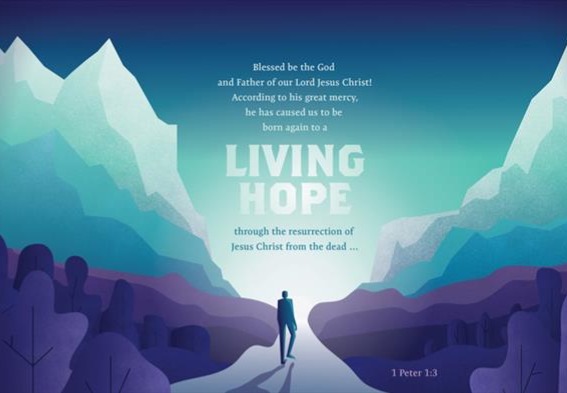
3 Blessed be the God and Father of our Lord Jesus Christ! By his great mercy he has given us a new birth into a living hope through the resurrection of Jesus Christ from the dead, 4 and into an inheritance that is imperishable, undefiled, and unfading, kept in heaven for you …
Notice that little expression Peter uses: “a living hope.” Living water was water in flowing stream. Living water was water that was going somewhere not just sitting in a stagnant pond. In v. 3–4 Peter tells them that they have a living hope that comes about through the resurrection of Jesus Christ from the dead. As we have seen in many Bible readings in recent weeks, Jesus died but God raised him to life again — he was resurrected — so, Christians believe that those who trust their lives to Jesus can be confident that we will also rise to new life. And if that’s the case, Christians have something great to look forward to. Peter calls this an “inheritance.” And notice the way Peter describes this inheritance. It is “imperishable, undefiled, and unfading …” That’s why Peter calls it “a living hope.”
I’m a fan of most types of music, although I must’ve meant that rap is not generally one of them. However, when I was reading these words again this week, I was reminded of the chorus line of a song from way back in 1990 by the American rapper MC Hammer: “U Can’t Touch This”. That’s what Peter saying here. No one can touch this because it is being kept safe by God! (Maybe MC Hammer made this connection because he later became a Pentecostal minister.)
3. WHAT WILL KEEP THEM GOING? – Protected by the Power of God (v. 6–11)
But how did this help the Christians Peter was writing to if they still “suffer various trials”? How is this “a living hope” if their faith is regularly tested? Peter doesn’t pretend that they will not suffer and that their faith will not be tested. But, he says, they need to see these things in terms of God’s big picture. He says that whatever happens in this life they are people
5 who are being protected by the power of God through faith for a salvation ready to be revealed in the last time.6 In this you rejoice, even if now for a little while you have had to suffer various trials, 7 so that the genuineness of your faith—being more precious than gold that, though perishable, is tested by fire—may be found to result in praise and glory and honour when Jesus Christ is revealed. 8 Although you have not seen him, you love him; and even though you do not see him now, you believe in him and rejoice with an indescribable and glorious joy, 9 for you are receiving the outcome of your faith, the salvation of your souls.
And God can even use these “trials” for good. They are able to train Christians so that our faith will become stronger and stronger. Just like the effort of working out in a gym can build our physical strength, so trials can build our spiritual strength.
So, what about us? If you’re like me, then there may have been times when you wondered if you had enough faith to keep going in the Christian life, to remain faithful to Jesus. You may even be in one of those times now. It seems clear that that’s how some of these early Christians were feeling. How do we deal with that? Another song from even further back in the 1980s says, “When the Going Gets Tough, the Tough Get Going” (Billy Ocean, 1985). But that’s not what Peter says. Instead of looking inside ourselves, Peter urges us to look outside and to remember that God has already given us “a living hope” in Jesus Christ. God has given us a life now with Christ and promised us a life in the future with Christ because Christ has already died and been resurrected for us.
Speaking about this section of Peter’s letter, my former Senior Minister Chris who I mentioned earlier, wrote these words which I have found very helpful:
What is that drives you? What is it that motivates you to keep going as a Christian? Is it a fear of failure, of being found out? That’s what motivates some Christians. They try so hard to live up to God’s standards because they think if they fail, they might miss out. But that’s not what we read here is it? You’ve been chosen and destined by God to be obedient to Christ and to be sprinkled with his blood. God has chosen you not the other way around. God is protecting you, so you’ll receive the salvation he’s prepared for you. We run a race, but it’s not a race where there’s only one winner. This isn’t a Powerball draw we’re talking about. No, this is a race where everyone who finishes gets the prize; and it’s a race where the judge is on the sidelines urging us on and giving us the strength to keep going.
Amen